
Key Takeaways
- B2B appointment setting services can book sales meetings with your closers, enabling your reps to stop spending all of their time prospecting and start selling.
- Pricing isn’t singular. It changes depending on language, time zone, seniority, and the extent to which each prospect gets qualified.
- Fee-for-service pricing rewards depth and research. Pay-for-performance pricing, meaning pay per lead or pay-per-appointment, rewards volume. Neither is wrong, but they pull in opposite directions.
- An in-house team is usually more expensive than outsourcing. Outsourcing moves tooling and hiring off your books. The median tenure of an inside sales rep is 1.9 years.
- Language coverage can determine whether you have a stalled pipeline, in which case a partner who covers multiple languages may be worth the investment.
Cold calling is the absolute worst part of the job for more than half of all sales reps. It is not a morale issue. It is a capacity issue.
According to Salesforce, 4,050 sales reps spend just 40% of their time selling each week. They spend nearly one entire workday on prospecting, and 48% of reps say it still leaves them without sufficient capacity to perform cold outreach. So they rush the calls or skip them, and a thin pipeline is the result after a quarter.
This is exactly the problem for B2B appointment setting. A trained team takes all the work for qualifying leads and scheduling appointments for your sales team. In this scenario, sales reps get to focus on what they should be getting paid for.
This guide explains how B2B appointment setting services work and how it differs from competing service providers. It also helps you understand how the service pricing model works and how to achieve a full calendar rather than a room full of no-shows.
If you want to identify where your funnel leaks, just ask for a quote.
What Is B2B Appointment Setting?
B2B appointment setting is the process of contacting businesses, assessing them, and scheduling a meeting for one of your sales representatives. It exists between the prospecting and closing phases. A setter does not try to close the deal. Their only goal is scheduling a meeting with someone who can buy.
Most B2B appointment-setting services use phone, email, LinkedIn, and SMS. The setter researches the account and dials the decision-maker, determines fit against your customer profile, addresses objections, and schedules the appointment.
If you outsource appointment setting, you give this motion to an external team instead of hiring the setters. The best services also cover message reminders, appointment re-schedules, and no-show follow-ups. An empty appointment on your calendar is not a result.
How Is Appointment Setting Different From Lead Generation?
Lead generation is a process that delivers contact data and some kind of intent signalling. B2B appointment setting fills your sales representative’s calendar with confirmed meetings.
| Lead generation | B2B appointment setting | |
|---|---|---|
| Deliverable | Agents fluent in the languages your customer use and able to support regional dialects | Native-speaking agents supporting businesses in 146 languages |
| Qualification depth | Industry experience, client reviews, and case studies | Operating for more than 15 years, serving businesses such as startups and multinational companies across 127 countries |
| Success metric | Efficient and structured processes for onboarding, agent training, call monitoring, quality checks, and reporting | Shared CSAT ratings and continuous feedback loops |
| Who follows up | Strong data-handling policies and secure systems that follow industry regulations | PCI DSS, GDPR, BBB A+ |
| Typical waste | Can expand or quickly support your team while maintaining quality customer service during peaks and rapid business growth | Easily scale up for peaks without a lock-in period with the help of more than 5,478 agents worldwide |
If your sales representatives have leads, more lead generation makes it worse.
How Do B2B Appointment Setting Services Work?
Complete B2B appointment setting services run in six steps. Ask a provider to walk you through each one, because the weak link is rarely the dialling. It is the qualification, confirmation and no-show recovery around it.
Step One: Define the Ideal Customer Profile
The capture of each downstream step relies on who we consider a prospect. A good provider pushes back to understand the deal size, industry, and the functions that actually sign. Narrow defines better than broad. A tight profile of 800 accounts beats a broad profile of 8,000 accounts.
Step Two: Build and Validate the Prospect List
Fast decay of data makes recycled lists deadly to outbound campaigns. The team should source contacts, verify emails and direct dials, and remove any contacts that are already in the CRM. Also, determine who has ownership of that data, which should be you.
Step Three: Create and Refine the Messaging
Scripts are created at the persona level, not campaign level. A finance director and an operations manager are concerned about different things. Hence, a single script for both wastes the market. Expect 2 to 3 revisions in the first month once actual objections come in.
Step Four: Run Coordinated Multichannel Outreach
Calls and email campaigns should be combined with LinkedIn touches for a single outreach cadence. A cold call should never land out of context after a cold email. It should reference it. Sequencing should be considered along with volume, and a good B2B appointment setting service provider outperforms freelancers on this step.
Step Five: Qualify The Prospect and Book The Meeting
Each interested lead is evaluated against a set of criteria, and if successful, a meeting is scheduled. The meeting is logged to your CRM with the invitation accepted and some notes for your salesperson. Wasted meetings happen with a handoff that has little to no context.
Step Five: Qualify The Prospect and Book The Meeting
Confirmation occurs when the meeting is scheduled and then the day prior. If the scheduled meeting is missed, do not chalk it up to a loss; try to reschedule. Reporting should include a call recording and should include the show rate, as well as the value of the pipeline, and not just the number of scheduled appointments.
What Determines The Cost Of B2B Appointment Setting Services?
As scope varies, so does pricing. Two services that book the same number of appointments may be very different in the scope of work completed behind the scenes.
Which Factors Move The Price Up Or Down?
These are the factors that a service provider bases pricing on. The answers you provide on the first call will impact the pricing the most.
Personalize Customer Interactions
Using customer history and previous interactions helps support teams deliver more relevant, personalized assistance that strengthens customer relationships.
Resolve Issues Effectively
Empower agents to solve problems during the first interaction whenever possible. First-contact resolution reduces customer effort and increases satisfaction.
Gather and Act on Customer Feedback
Customer surveys, reviews, and direct feedback provide valuable insights into service gaps. Acting on this feedback demonstrates a commitment to continuous improvement.
Customer Experience Management Best Practices
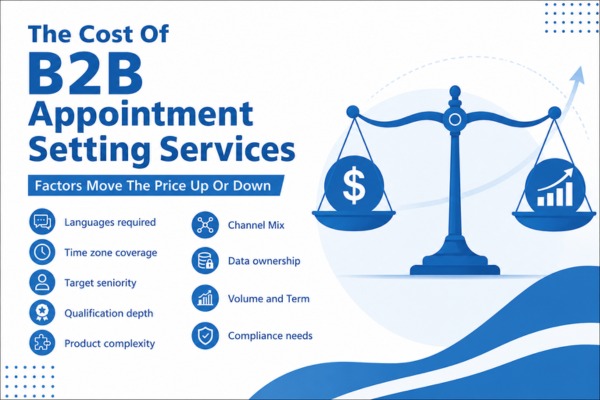
- Languages required: Native speaker outreach in German, Japanese, or Mandarin is more costly than English outreach and is more effective in those respective markets.
- Time zone coverage: One region is one price. Follow-the-sun coverage is another.
- Target seniority: Reaching an operations manager is not comparable to reaching a finance director.
- Qualification depth: A light interest check is less expensive than a full budget, authority, need, and timing check.
- Product complexity: More training is required for technical products that have more complexity.
- Channel Mix: Programs that rely on the phone more than email increase cost per touch.
- Data ownership and building your own trusted list: You save money on the first. You pay more when the provider has to build it.
- Volume and Term: Sustained programs win on unit economics over one-month pilots
- Compliance needs: Regulated industries require script approvals, additional QA and audit trails.
What Types Of Pricing Do Providers Use?
There are two families. You’ll almost always be rewarding opposite behaviour based on which one you choose.
| Model family | How you pay | What it rewards | Best fit |
|---|---|---|---|
| Fee for service (retainer, project, hourly) | Fixed monthly or scoped fee | Depth, research and relationship building | Complex sales, long cycles, senior targets |
| Pay for performance (per lead, per appointment) | Only on a delivered outcome | Volume and speed to first result | Simple offers, short cycles, quick tests |
Both models are legitimate. You should pick the one that best supports your sales.
How Do B2B Appointment Setting Services Work?
Complete B2B appointment setting services run in six steps. Ask a provider to walk you through each one, because the weak link is rarely the dialling. It is the qualification, confirmation and no-show recovery around it.
Step One: Define the Ideal Customer Profile
The capture of each downstream step relies on who we consider a prospect. A good provider pushes back to understand the deal size, industry, and the functions that actually sign. Narrow defines better than broad. A tight profile of 800 accounts beats a broad profile of 8,000 accounts.
Step Two: Build and Validate the Prospect List
Fast decay of data makes recycled lists deadly to outbound campaigns. The team should source contacts, verify emails and direct dials, and remove any contacts that are already in the CRM. Also, determine who has ownership of that data, which should be you.
Step Three: Create and Refine the Messaging
Scripts are created at the persona level, not campaign level. A finance director and an operations manager are concerned about different things. Hence, a single script for both wastes the market. Expect 2 to 3 revisions in the first month once actual objections come in.
Step Four: Run Coordinated Multichannel Outreach
Calls and email campaigns should be combined with LinkedIn touches for a single outreach cadence. A cold call should never land out of context after a cold email. It should reference it. Sequencing should be considered along with volume, and a good B2B appointment setting service provider outperforms freelancers on this step.
Step Five: Qualify The Prospect and Book The Meeting
Each interested lead is evaluated against a set of criteria, and if successful, a meeting is scheduled. The meeting is logged to your CRM with the invitation accepted and some notes for your salesperson. Wasted meetings happen with a handoff that has little to no context.
Step Six: Confirm, Recover No-shows, and Report
Confirmation occurs when the meeting is scheduled and then the day prior. If the scheduled meeting is missed, do not chalk it up to a loss; try to reschedule. Reporting should include a call recording and should include the show rate, as well as the value of the pipeline, and not just the number of scheduled appointments.
What Determines The Cost Of B2B Appointment Setting Services?
As scope varies, so does pricing. Two services that book the same number of appointments may be very different in the scope of work completed behind the scenes.
Which Factors Move The Price Up Or Down?
These are the factors that a service provider bases pricing on. The answers you provide on the first call will impact the pricing the most.
- Languages required: Native speaker outreach in German, Japanese, or Mandarin is more costly than English outreach and is more effective in those respective markets.
- Time zone coverage: One region is one price. Follow-the-sun coverage is another.
- Target seniority: Reaching an operations manager is not comparable to reaching a finance director.
- Qualification depth: A light interest check is less expensive than a full budget, authority, need, and timing check.
- Product complexity: More training is required for technical products that have more complexity.
- Channel Mix: Programs that rely on the phone more than email increase cost per touch.
- Data ownership and building your own trusted list: You save money on the first. You pay more when the provider has to build it.
- Volume and Term: Sustained programs win on unit economics over one-month pilots
- Compliance needs: Regulated industries require script approvals, additional QA and audit trails.
What Types Of Pricing Do Providers Use?
There are two families. You’ll almost always be rewarding opposite behaviour based on which one you choose.
| Model family | How you pay | What it rewards | Best fit |
|---|---|---|---|
| Fee for service (retainer, project, hourly) | Fixed monthly or scoped fee | Depth, research and relationship building | Complex sales, long cycles, senior targets |
| Pay for performance (per lead, per appointment) | Only on a delivered outcome | Volume and speed to first result | Simple offers, short cycles, quick tests |
Both models are legitimate. You should pick the one that best supports your sales.
Is Pay-Per-Appointment The Less Risky Option?
The risk of pay-per-appointment is less to you, since you only pay for the appointment. However, the provider will make it up by fighting for appointment volume.
This works on simple offers and short test cycles. Pay-per-appointment does not work well on enterprise sales. There are three terms you should agree to: criteria for qualifying an appointment, who is accountable for a no-show, and whether a reschedule counts as a second billable appointment.
Why Do Most Providers Quote Instead Of Publishing Rates?
Because a published rate would be wrong for almost everyone reading it. An English SMB calling program and a Japanese technical campaign have only a label in common.
The market sets the spread. Clutch’s appointment setting directory had 1,576 companies listed in August 2026, from freelancers offering a single language to global contact centers. Agents Republic tailors each program and provides a quote based on your language, coverage hours, and qualification rules.
Which Providers Offer The Best B2B Appointment Setting Services?
There are four provider types, and they fail in different areas. Pick the model that best fits your market, not the most aggressive brand.
Specialist Appointment Setting Agencies
These agencies are specialists in outbound selling. You can expect good reporting and sales craft, but their reach is limited to English calling from one time zone, and their services are priced for retainer clients, making them out of reach of smaller sales teams in new markets.
Freelance Setters And Marketplace Platforms
These are the fastest and cheapest ways to set up an appointment setting service, but you assume the risk. You also may not have compliance coverage, and the quality of constant staff turnover can swing weekly. Fine for a first test, not for continuing growth.
In-House Sales Development Teams
Technical sales requires in-depth knowledge of the product, along with full control. This is the most time-consuming and expensive route to choose.
Teams typically have one sales rep for every 2.4 account executives. Salary is the least costly aspect of the total once you factor in management, tools, and ramp. Each rep departure resets the clock to zero.
Multilingual BPO Partners
This is where outsourced appointment-setting services scale: coverage across time zones, outbound calls, and inbound calls. Agents Republic sits in this category: a Canadian BPO in Vancouver with agents in over 120 countries, and coverage across over 75 languages.
It is an accredited BBB business with an A+ rating and is PCI DSS certified and GDPR compliant. The real limit may be ultra-niche C-suite prospecting in a single market, which may still suit a boutique specialist better.
| Agency | Freelancers | In house | Multilingual BPO | |
|---|---|---|---|---|
| Languages | Usually English | One, sometimes two | Whatever you hire | 75 plus |
| Coverage | One time zone | Ad hoc | Office hours | 24/7 |
| Setup speed | Weeks | Days | Two quarters | Weeks |
| Compliance | Usually | Rarely | Yours to build | Certified |
| Inbound follow-up | No | No | Separate team | Same contract |
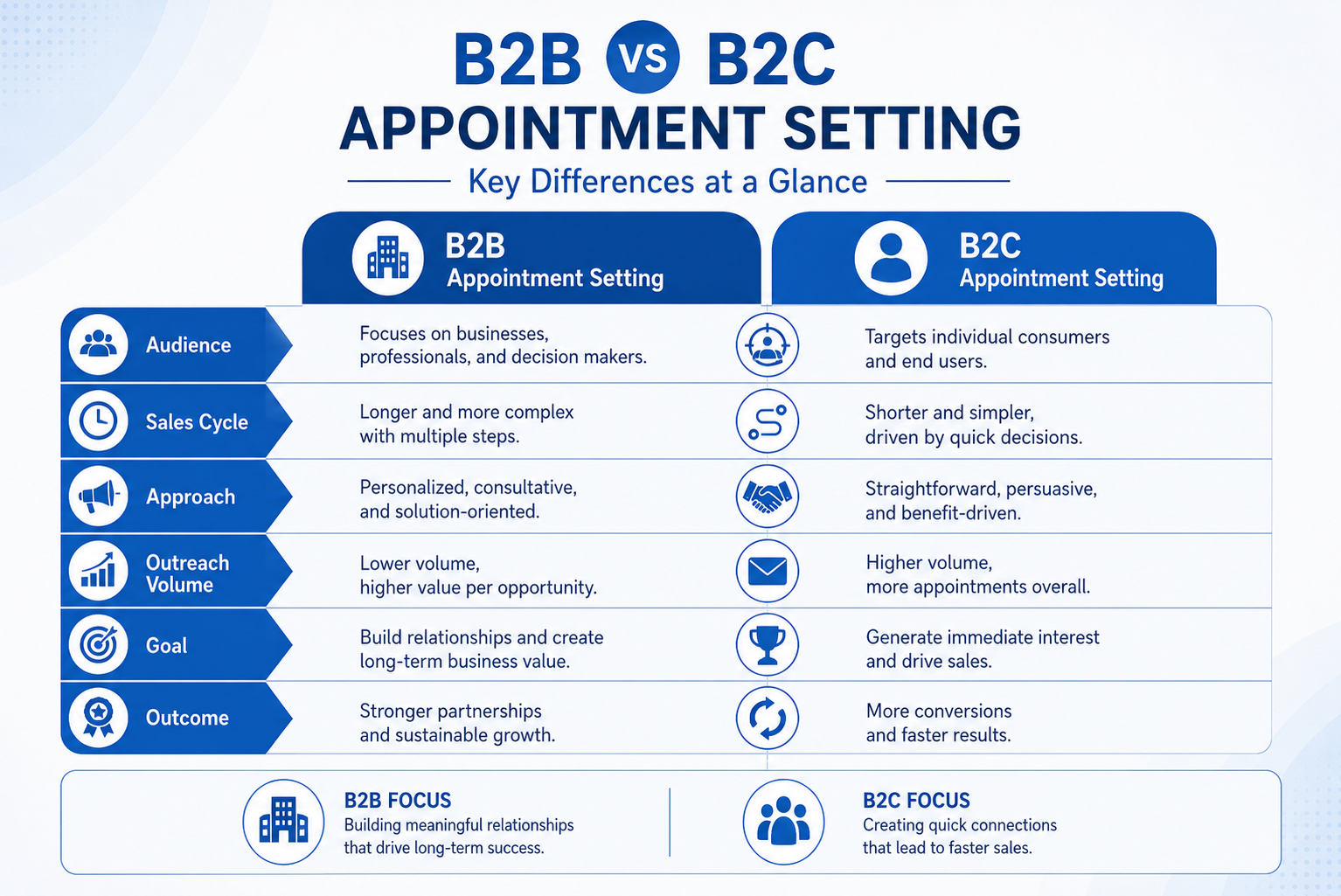
Difference between B2B Appointment and B2C Appointment?
How Do You Choose The Best B2B Appointment Setting Services?
Every salesperson sounds the same on a first call. These six questions will filter the good from the bad.
- Ask for the definition of a qualification in writing. If they can’t state it in one sentence, they don’t have one.
- Ask for campaign call recordings. Not just the good calls. Watch them as they react to a “bad” call.
- Check language and time zone coverage against your actual markets. Gaps in coverage will translate to radio silence.
- Verify compliance knowledge. GDPR, CASL, and TCPA form the legal framework of outbound calling in different regions.
- Aim for a show rate goal in addition to a booking goal. The number of booked calls and the number of held calls differ.
- Read actual reviews on sites like Clutch or G2 rather than the provider’s testimonial page.
Our RFI for call center outsourcing converts these questions into a scored request you can send to three providers simultaneously.
Ready to compare apples to apples? Talk to our team and bring your current numbers.
Best Practices for High-Performing B2B Appointment Setting Services
Discipline, not talent, is the main difference between a mediocre and strong program. Discipline shows up in six places.
Narrow Your Target Before You Broaden Your Volume
Dialling broadly into a vague list only results in more rejection and a worse pipeline. Desired accounts need to be narrowed, and a reason why they should be explained in one line.
Lead With A Problem That Your Product Solves
According to Gartner, 75% of B2B buyers prefer to self-serve, which means your outreach call needs to be worthwhile. Start by explaining how your product solves their problem. Leave your product walkthrough for the meeting.
Lead With A Problem That Your Product Solves
Gartner states that buyers are 1.8x more likely to complete high-quality deals when they use supplier digital tools, in addition to engaging with a sales rep. Send over a case study, and let the sales rep reference it.
Call Prospects In A Language That They’re More Comfortable In
A German lead would take a meeting in German, but would most likely say no in English. Because of that, a multilingual B2B appointment setting service over an English-only service is the better option when taking calls within EMEA and APAC.
Confirm Meetings At Least Twice
First, when they schedule. Second, the day before, giving a human reply path. Show them that your response rate rises with the second touch, and it helps them reschedule faster.
Use Negative Responses To Shape Your Sales Pitch
The responses you receive as to why you don’t win the sale are the reasons you should be using in your sales pitch the following month. Teams that review objections on a weekly basis show improvement; teams that do it on a quarterly basis hit a wall.
Agents Republic ran a calling campaign for a leading consulting firm in six countries, using Mandarin, Cantonese, German, French, Spanish and English. The client’s project manager stated that the secret to this campaign was not only the call itself, but also the speed at which theirs was mobilized and the adjustments that were made to fit their needs mid-campaign. Read it with other client case studies.
What Are The Limitations And Risks?
They never mention these during a sales call, so here’s the reality.
- B2B Appointment Setting Services cannot help a weak offering. It only spreads the problem to a larger audience.
- It takes 30 to 90 days to achieve a decent ramp. Anyone selling instant access is faking it.
- Technical and particularly C-level sales might need dedicated appointment setters.
- There is brand risk. Agents represent your brand. So, train them well, script carefully, and monitor the quality of all calls prior to ramping up business volume.
- There’s no such thing as cheap. In this business, it means no-shows, unqualified meetings, and frustrated reps.
If a provider has nothing to say to these situations, that’s a red flag. Our guide to outsourcing call centers explains how to protect yourself against these issues.
Final Thoughts
B2B appointment setting services aren’t a miracle worker, and with over a thousand competitors, it’s easier than ever to pick the wrong option. Reputable companies will explain their qualification process, play a poor example of a call, explain pricing, and show the rate before volumetrics.
Once the four are taken care of, B2B appointment setting services cease being a difference in your budget and start being the reason your reps show up on Mondays.
Are you ready to fill your reps’ calendars with meetings that are actually going to happen? Get a quote from Agents Republic or call +1 833 645 8400.
Frequently Asked Questions (FAQs)
What is a B2B appointment setting in simple terms?
This means booking qualified sales meetings for your reps with prospects that fit your profile.
How many meetings should I expect from a B2B appointment setting service?
In the mid-market, expect 8 to 20 meetings per month. Enterprise-level campaigns rely on fewer, higher-value meetings.
How long does it take to ramp with a B2B appointment setting service?
30 to 90 days should be expected. The first four weeks are dedicated to research and messaging testing. Volume follows script revisions.
What is a good show rate?
This is normally around 75 to 85%. A rate less than that signifies a weak confirmation or poor prospect qualification.
Do B2B appointment setting services work beyond English markets?
Absolutely! Especially if you’re able to reach out in the buyers’ native language, it’s likely less competitive.
Do B2B appointment setting services provide inbound support?
Yes. One partner for booking and inbound eliminates the handoff gaps where context is lost.
What should we track weekly?
Meetings booked, meetings held, show rate, qualification pass rate and pipeline value. Everything else is a distraction.

