
Key Takeaways
- Inbound services respond to customers who contact you; outbound services contact people first.
- Inbound work is judged by speed and resolution; outbound work is judged by reach and results.
- Outbound calls to Canadians are subject to Canada’s CRTC calling hours and National Do Not Call List restrictions.
- Many companies prosper when a single trained team handles both sides.
- Dedicated teams are for +100 languages, complex work and campaigns; shared plans are for simple inbound calls in English.
Only 14% of customer service issues are fully resolved through self-service. Everything else lands with a person, often on the phone. The real question is which way your agents should work. This guide compares inbound vs outbound call center services and shows how to choose.
Know your call mix? Request a quote, and we’ll recommend a model.
What Are Inbound Call Center Services?
Inbound call handling refers to any customer interaction the customer initiates. An inbound call center is reactive, meaning agents wait for calls from customers. Our call center services for businesses handle this work via phone, email, chat, and social media.
Common Types of Inbound Call Center Services
- Customer service lines: Agents respond to queries, update accounts, and handle customer complaints.
- Orders and payments: Our order-taking services use PCI DSS-secure phone payments.
- Help desk support: Our technical support team covers software, hardware, and SaaS.
- Bookings: Agents book, move, and cancel visits through our bookings and reservations service.
- Overflow and after-hours answering: Agents answer during high-volume periods and out of hours, such as nights and holidays.
Benefits of Inbound Call Center Services
- When self-service fails, customers connect with people.
- Each call reveals common questions and product issues.
- Many people want to contact a human.
What are Outbound Call Center Services?
Outbound calling services encompass all of the calls your business initiates. An outbound contact center is proactive, meaning that the agents call people first. Much of this work isn’t just selling; it’s outbound customer service.
Common Types of Outbound Call Center Services
- Welcome calls: Usually made in the first 30 days of onboarding through our welcome and retention calls service.
- Retention calls: Agents contact selected key customers to get their feedback and anticipate risk.
- Lead qualification: Agents verify need, budget availability, and timing before a lead reaches sales.
- Meeting booking: Our sales support services book qualified meetings for your closers.
- Surveys and reminders: Agents query the nature of the service and remind customers to renew.
Benefits of Outbound Call Center Services
- Revenue does not wait for customers to call.
- Agents can identify issues before customers leave, improving retention.
Inbound vs Outbound Call Center Services | Key Differences
The only thing that matters is who makes the call. Inbound is when the customer calls an agent. Outbound is when an agent makes the initial contact with the customer or prospect.
That difference alters the goal, the skill set, and the regulations. Inbound agents are expected to solve problems and must be patient and knowledgeable about the product.
Outbound agents have an objective such as booking a meeting or renewing a contract. They need a clear script, a soothing voice, and thick skin.
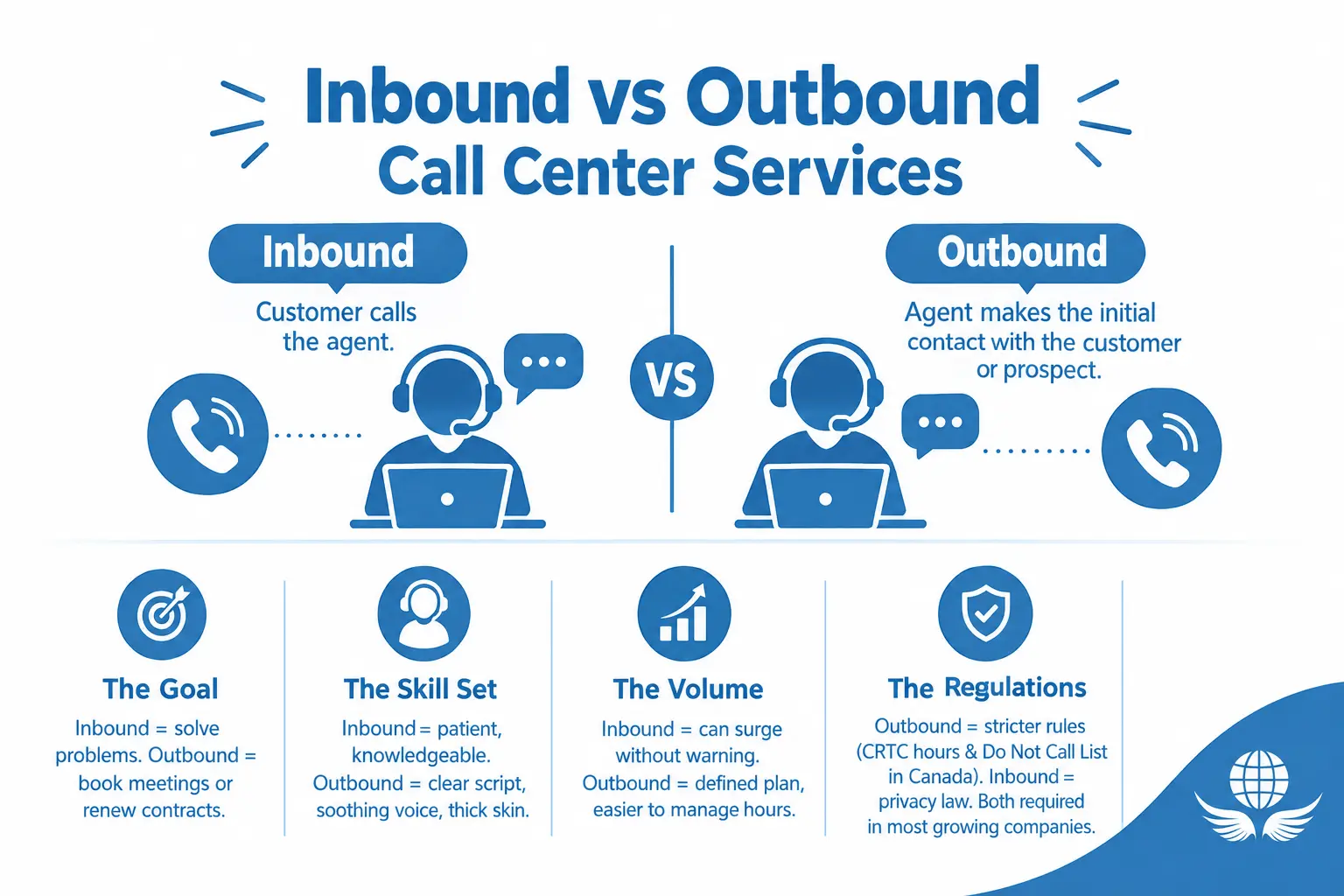
Inbound teams respond to customer demand, which can surge without warning. Outbound teams have a defined plan, and hours are easier to manage.
Outbound calls are also subject to stricter rules. In Canada, they must adhere to CRTC calling hours and the National Do Not Call List. Inbound calls are primarily governed by privacy law. Both are required in most growing companies.
| Factor | Inbound | Outbound |
|---|---|---|
| Who starts the call | The customer | The agent |
| Main goal | Resolve the issue | Reach a result |
| Core tools | IVR, routing, ticketing | Dialer, contact lists, CRM |
| Legal focus | Privacy law | Privacy law plus call rules |
Call Purpose and Direction
Inbound teams use IVR menus and skill-based routing to direct each client to the appropriate agent. Outbound teams rely on predictive dialling techniques that dial multiple numbers and route answered calls to available agents.
Customer Interaction and Business Goals
Inbound callers have a reason to speak, and agents focus on the fix. Outbound contacts aren’t expecting the call, so agents need to grab their attention quickly.
Inbound work is about retaining revenue, and outbound work is about generating revenue or saving accounts at risk.
Performance Metrics and Success Rates
Use a separate scorecard for each direction. For inbound teams, agent productivity is contacts solved per hour. For outbound teams, it translates to productive calls per hour.
| Area | Inbound Metric | Outbound Metric |
|---|---|---|
| Speed | Average speed of answer | Contact rate |
| Outcome | First-call resolution | Conversion rate |
| Customer view | Satisfaction score | Complaint and opt-out rate |
When Does Your Business Need Inbound Call Center Services?
Inbound support is necessary when customers try to contact you but can’t.
Managing High Volumes of Customer Inquiries
Long holds, after-hours voicemail, and dropped calls are telltale signs. Your lines can become overwhelmed during a launch or outage. Our Erlang staffing calculator lets you determine how many agents you need based on calls per hour and average handle time.
Providing Technical Support and Troubleshooting
Product faults require trained agents, not generic scripts. Tier 1 agents handle standard issues and escalate complex ones to your engineers with all the relevant information.
Improving Customer Satisfaction and Retention
A quick, clear answer helps customers stay loyal. With good inbound customer service, a complaint becomes a reason to stay. Experience inbound contact center solutions in real time and see how they enhance your customer experience.
When Does Your Business Need Outbound Customer Services?
You need outbound support when deals fall through because you lack inbound support.
Generating Leads and Driving Sales
Outbound teams generate leads and make telemarketing calls to new prospects. Our guide to B2B appointment setting services explains how booked meetings reach your closers.
This work is also highly regulated. Telemarketers in Canada have limited calling hours: 9:00 a.m. to 9:30 p.m. Monday through Friday and 10:00 a.m. to 6:00 p.m. on weekends. The CRTC may fine a corporation up to $15,000 for each violation.
The National Do Not Call Registry was active for approximately 258.5 million people as of September 30, 2025, in the U.S.
Following Up With Prospects and Customers
Warm leads cool quickly and often go unanswered. Reminder calls can also reduce missed appointments and renewals. In Canada, customers who did business with you in the last 18 months are exempt from the National DNCL; however, calling hours still apply.
Conducting Surveys and Customer Outreach
Survey calls verify satisfaction after a purchase. The National DNCL in Canada does not apply to real market research calls and calls made during surveys. CASL covers text outreach, which requires consent before sending a sales message.
Can Your Business Use Both Inbound and Outbound Call Center Services?
Yes. A blended team consists of trained agents shared between queues.
Benefits of Combining Both Services
- Agents make outbound calls when inbound traffic is low, reducing idle time.
- One team has all product information and customer history.
- Outbound call campaigns are enhanced by insights gathered from inbound calls.
The risk is getting an inbound spike during a campaign, so have clear rules for switching back.
Examples of Integrated Inbound and Outbound Support
| Business | Inbound Work | Outbound Work |
|---|---|---|
| SaaS company | Tier 1 technical help | Welcome calls in the first 30 days |
| Online store | Order and delivery questions | Calls to recover lost carts |
| Clinic or service firm | Bookings and changes | Appointment reminders |
In our welcome and retention programs, agents make outbound calls during quiet inbound periods. Our guide shows how to reduce cart abandonment in retail.
Looking to create a blended program? Call us at +1 (604) 210-8100.
In-House vs Outsourced Call Center Services
You can run both options in-house or through a partner.
Building an In-House Call Center
An in-house customer support team gives you direct control. It also involves recruitment, training, software, and supervision. Small teams often struggle to cover nights, weekends, and multiple languages.
Outsourcing Inbound and Outbound Services
Outsourcing provides trained agents and tools, without the need to build a team. The trade-off is reduced day-to-day control, which makes clear processes even more important. Our guide to outsourcing call centers walks you through the entire process.
Choosing the Right Call Center Partner
- Check languages. Ask which languages have native agents today.
- Check compliance. Ask for proof of DNCL registration, PCI DSS, and GDPR.
- Review the pricing model. Ask about per-minute and per-coverage-hour rates.
- Run a pilot. Use one queue or one campaign.
Our RFI questions for call center outsourcing add more.
How to Choose the Right Call Center Services for Your Business
Here are 4 steps to compare inbound vs .outbound customer services for your business.
Identify Your Business Goals
State the problem name first. Missed calls indicate inbound. Stalled leads indicate outbound.
Evaluate Call Volume and Customer Needs
Label call log for 3 months showing direction and type. Note peak hours, languages, and the difficulty of most calls.

Simple calls suit a shared model, while complex or multilingual work suits a dedicated team.
Think about Budget, Staffing, and Coverage
Shared plans are billed by the minute and are English-only. Dedicated teams are charged by coverage hours, so you are not charged per call. We have a call center pricing guide that outlines the various price models.
Define Your KPIs and Service Requirements
Set goals before launch; focus on answer speed or booked meetings. Agree on reporting and quality checks in writing.
How Agents Republic Supports Inbound and Outbound Customer Service Needs
We are a call center outsourcing Canada provider based in Vancouver, with offices in Toronto and Budapest. We offer two models.
| Model | Best For | Billing | Languages |
|---|---|---|---|
| Shared support | Simple calls, FAQs and bookings | By the minute on published plans | English only |
| Dedicated support | Campaigns, technical and complex work | Agent hourly rate × coverage hours + fixed monthly supervision fee | Over 100 languages |
Shared plans appear on our 24/7 answering service page. Dedicated agents use your CRM, such as Salesforce or HubSpot, at no extra cost.
We offer bilingual customer service teams for Quebec programs. Check out all the languages we support. We are PCI DSS certified, GDPR compliant, and BBB A+ rated.
Final Thoughts
The difference between inbound vs. outbound call center services is whether the caller or the recipient initiates the call. Inbound safeguards the customers you already have. Outbound creates what comes next, and many businesses need both.
Call +1 (604) 210-8100 or contact our team to plan the right mix today.
Frequently Asked Questions (FAQs)
What are the key distinctions between inbound and outbound call center services?
It’s just a matter of who initiates the call. Inbound services respond to customers reaching out for assistance. Outbound services are sales, follow-ups, surveys, or renewals initiated to customers or prospects.
Inbound quality is judged by speed and resolution. Outbound is judged by contact rates and results, with more stringent calling rules.
Inbound vs Outbound Calling: What’s better for my business?
Both are good independently. If your customers have a hard time reaching you, get stuck on hold, or leave emails, choose inbound. If leads don’t convert, renewals aren’t completed, or new customers don’t complete setup, choose outbound.
Many expanding enterprises need both, so they start with the larger one and add the other later.
Can a call center handle both Inbound and Outbound calls?
Yes. A blended team answers inbound calls first, and makes outbound calls when traffic is low. This reduces idle time and keeps all product knowledge within one team.
It works best when rules for shifting queues are clear, so when a campaign experiences a big influx of inbound customers, they aren’t stuck on hold waiting for the next available agent.
Is it better to outsource inbound or outbound call center services?
Both can be outsourced quite successfully. Outsource inbound if you want more hours, overflow coverage, or more languages. Outbound is right for you when you need trained callers and safe processes quickly.
Keep work in-house when it needs specialized, scarce skills. For everything else, a pilot with one queue shows whether outsourcing is a fit.
What are the Inbound and Outbound Call Center Services Costs?
Call costs depend on the support model, not the call direction. Shared plans for simple English inbound calls are billed by the minute.
Dedicated teams are charged at agent hourly rates multiplied by hours covered, plus a monthly supervision fee. February typically has fewer hours of coverage and is therefore a less expensive month than months with 31 days.

