
Everyone has a story about terrible customer service: the 40-minute hold, the third transfer, the agent who reads a script while your problem gets worse. When customers get bad service, most don’t complain. They just leave. PwC found that 32% of customers would stop doing business with a brand they love after a single bad experience.
For a business, lousy customer service isn’t just an annoyance. It shows up in churn, reviews, acquisition costs, and lost revenue. Below, we break down 15 bad customer service examples and how to fix them, real brand stories, the root causes, and what poor service actually costs.
Key Takeaways
- Any interaction that leads to a frustrated, unheard, or without a fix.
- The most common complaints are long holds, having to repeat yourself, and repeated transfers.
- Poor service costs more than lost sales: churn, higher acquisition costs, bad reviews, and agent burnout.
- Some of the issues that lead to poor service include insufficient staffing, inadequate training, and obsolete systems.
What Is Considered Bad Customer Service?
Bad customer service is any interaction that leaves customers frustrated, ignored, or unsupported. In many cases, businesses fail to recognize service issues until customer complaints or negative reviews start increasing.
So, what is bad customer service in practice? It’s the gap between what a customer expects and what they actually get. It looks different by industry. In healthcare, it’s poor customer care at the front desk. In hotels, it’s bad guest service at check-in. In agencies and B2B, it’s bad client service on a missed deadline. The pattern is the same: the customer ends up doing the work.
Common Signs of Poor Customer Service
Several common indicators of poor customer service include:
- Slow response times
- Unresolved customer issues
- Lack of empathy from support agents
- Inconsistent communication across channels
- Long wait times and repeated call transfers
- These problems often signal deeper operational gaps that affect the overall customer experience.
Bad Customer Service vs. Good Customer Service
Here’s how the same moments look on each side:
| Factor | Bad Customer Service | Good Customer Service |
|---|---|---|
| Wait time | Long holds, no callback option | Short waits, or a callback at a set time |
| Routing | Transferred again and again | Reaches the right person the first time |
| Context | Customer repeats the story to every agent | Agent sees the history and picks up where it left off |
| Attitude | Scripted, dismissive or rude | Empathetic and clear |
| Knowledge | “Let me check” every time | Answers confidently, or knows who can |
| Ownership | Blames policy or the customer | Owns the problem until it’s fixed |
| Follow up | Promises a callback that never comes | Confirms the fix and checks back |
Poor Customer Service Examples in Business
Poor customer service examples in business can look different across industries, but the outcomes are usually the same: frustrated customers and lost trust.
Examples include:
- Ignoring complaints on social media
- Delayed refunds or billing disputes
- Support agents lacking product knowledge
- Customers repeating information multiple times
- Overly scripted responses that feel robotic
Customers today expect fast, personalized, and seamless support. When businesses fail to deliver, customer loyalty quickly declines.
We cover 15 bad customer service examples in detail, with how to fix each one, further down this page.
Why Businesses Overlook Service Issues
Many companies prioritize acquisition metrics over retention metrics. They invest heavily in marketing but fail to analyze customer feedback, support trends, or recurring complaints.
Poor coordination between support, sales, and operations teams also contributes to inconsistent customer experiences.
Root Causes of Bad Customer Service
The majority of customer service problems are not due to poor agents. It is the system around them that is causing them.
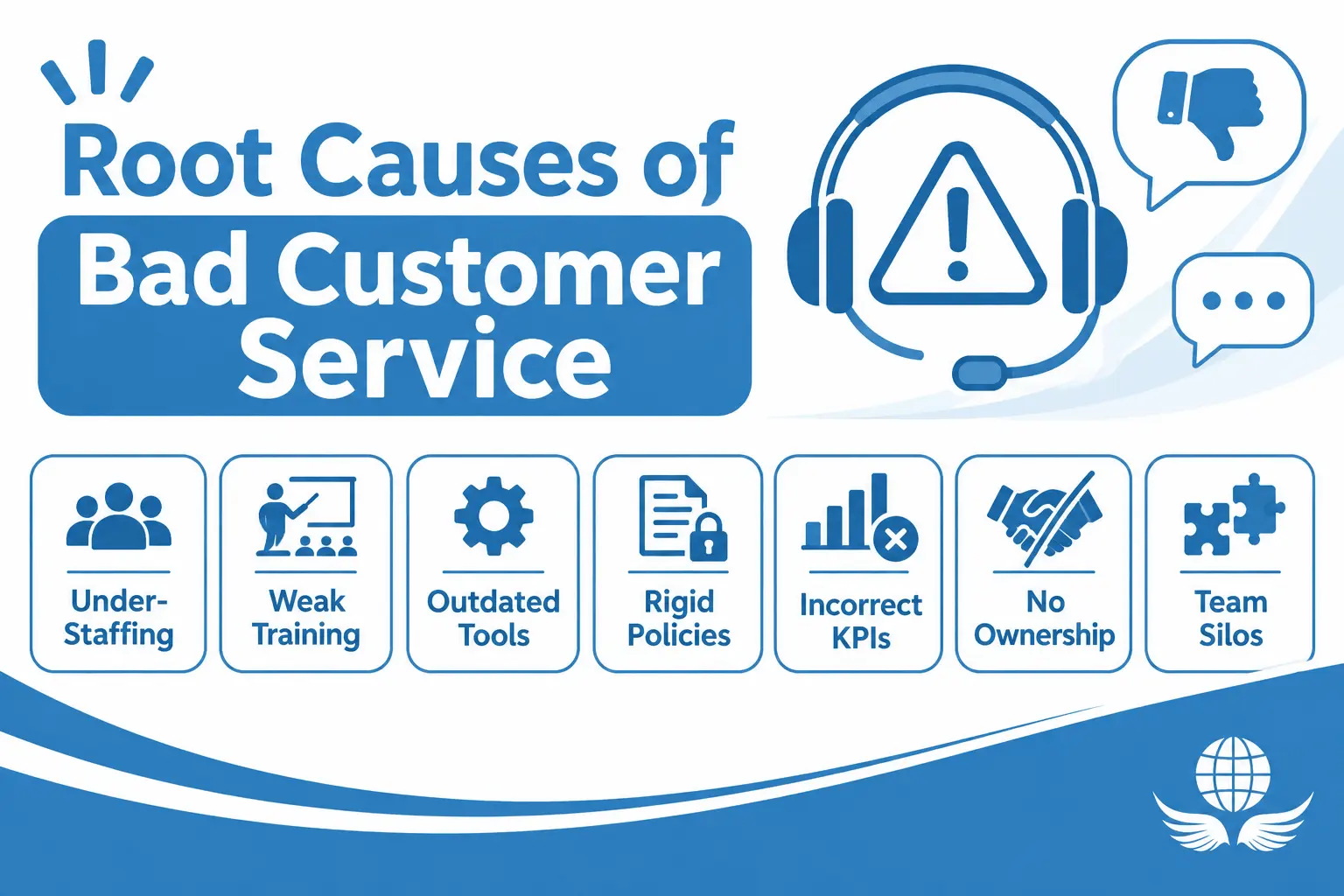
- Under-Staffing: insufficient number of agents during busy periods, resulting in growing queues and holding times.
- Weak training: agents do not know enough about the product or policies to resolve issues.
- Outdated tools: no shared customer history, so each agent begins at the base level.
- Rigid policies: agents cannot make reasonable allowances to loyal customers.
- Incorrect KPIs: agents are incentivized to complete calls quickly, leading to hurrying rather than helping.
- No ownership: nobody is responsible for the issue from start to finish.
- Team Silos: support, billing, and operations do not communicate with one another.
The Cost of Bad Customer Service
The effects of poor customer service on business performance are both immediate and long-term. Beyond customer frustration, businesses often face rising operational costs and declining revenue.
Lost Revenue From Customer Churn
When customers repeatedly experience poor support, they stop buying. Worse, acquiring replacement customers is significantly more expensive than retaining existing ones.
According to research from HubSpot, increasing customer retention can substantially improve profitability over time. According to Bain & Company research on over 8,000 utility customers, utility customers who experience poor customer service are even more likely to change providers than customers who are unhappy with the prices they pay.
This is especially important for subscription-based businesses and ecommerce brands where customer lifetime value drives growth.
A strong example is the European expansion case study from Agents Republic, where multilingual customer support helped improve customer experience and operational scalability for a US-based ecommerce company entering new markets.
Increased Customer Acquisition Costs
The cost of bad customer service also increases marketing expenses. As customer churn rises, businesses must spend more on advertising, lead generation, and promotions just to maintain revenue levels.
Retention is almost always more cost-effective than constant acquisition. According to one study on customer experience trends, nearly half of customers will defect after receiving just one negative experience, while 80% defect after multiple bad experiences.
Negative Reviews and Brand Reputation Damage
Online reviews heavily influence purchasing decisions. One unresolved issue can quickly spread through review sites and social media platforms.
Negative experiences also travel faster than positive ones. Poor customer interactions often become public examples of how not to treat customers.
And the damage sticks. According to Qualtrics XM Institute research, just 15% of consumers rating a company’s experience as ‘very poor’ are very likely to recommend it.
Operational Inefficiencies and Support Costs
Poor service processes create internal inefficiencies that affect multiple departments.
Common operational issues include:
- Repeat support tickets
- Escalated complaints
- Increased workload for agents
- Lower team productivity
For global businesses handling technical or multilingual support, these inefficiencies can scale rapidly. This technical support case study from Agents Republic demonstrates how streamlined support operations can improve service quality while reducing customer friction.
How Bad Customer Service Affects Revenue
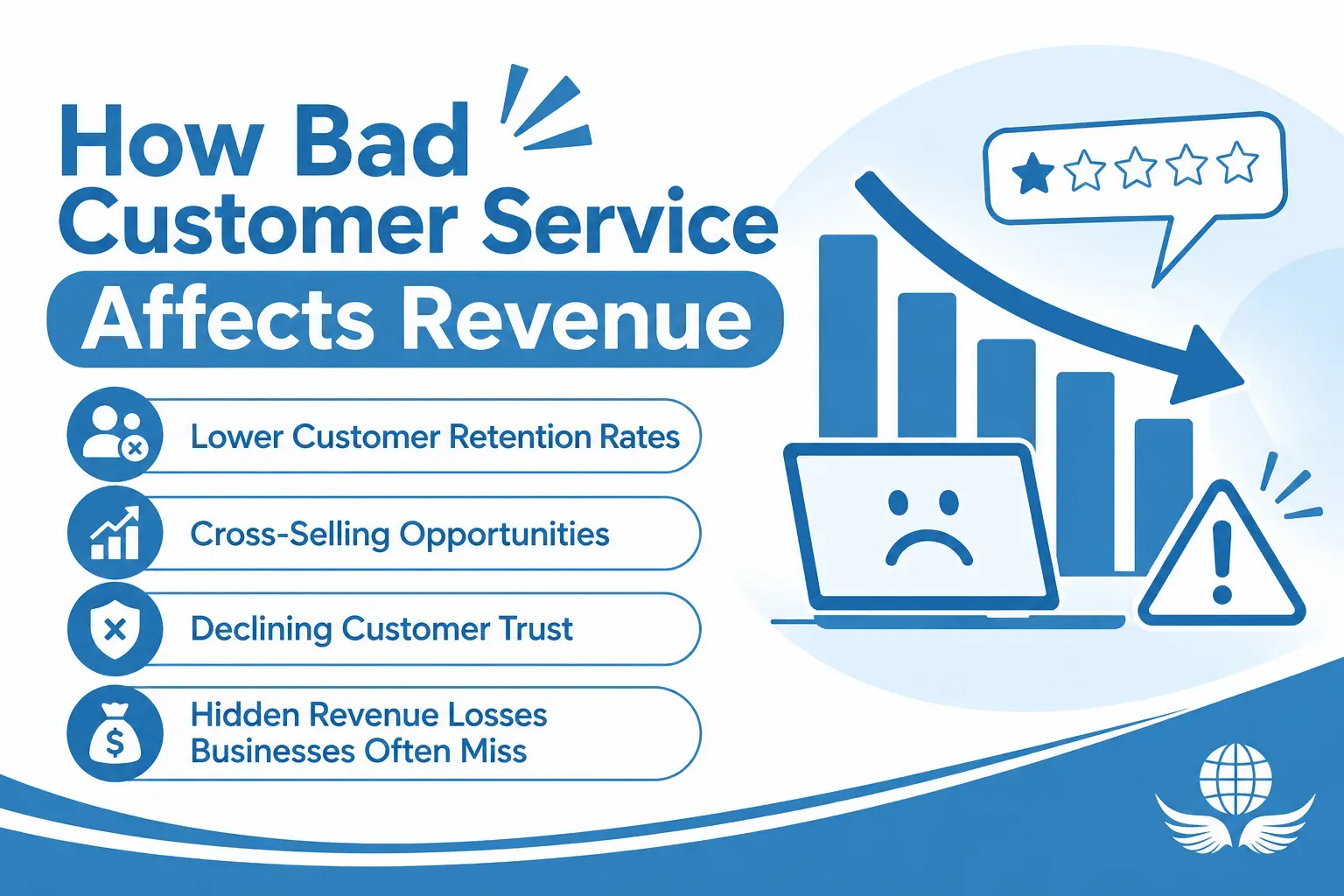
Many businesses underestimate how bad customer service affects revenue because the losses are often indirect.
Lower Customer Retention Rates
Customers are unlikely to stay loyal after repeated negative experiences. Even minor frustrations can reduce repeat purchases and recurring revenue.
Retention is closely tied to service quality. Businesses that consistently provide responsive and reliable support are more likely to build long-term customer relationships.
Reduced Upselling and Cross-Selling Opportunities
When customer trust declines, opportunities for repeat purchases and upselling also decrease. Negative experiences reduce opportunities for upselling, renewals, and referrals.
Declining Customer Trust
Trust takes years to build and only one poor experience to damage. Once customers begin doubting a company’s reliability, engagement drops. They may stop opening emails, cancel subscriptions, or switch to competitors entirely.
Hidden Revenue Losses Businesses Often Miss
Not every loss appears immediately in sales reports. Hidden revenue leaks often include:
- Silent customer churn
- Abandoned carts
- Missed referrals
- Lower repeat purchase rates
Most of these losses are silent. Many unhappy customers never complain. They simply stop buying. These small losses compound over time and significantly affect long-term profitability.
10 Bad Customer Service Examples (and How to Fix Them)
These are the bad customer service examples customers complain about most, especially on the phone, and what to do instead.
1. Long Hold Times With No Callback Option
The customer waits 30 minutes or longer with music, no update. According to one HubSpot survey, 57% of consumers stated that long hold times are the worst aspect of customer service.
How to fix it: Offer callbacks, announce expected wait times, and staff for peaks. The Erlang staffing calculator enables you to plan your agents.
2. Being Transferred Again and Again
Every transfer means a new agent, a new explanation, and a new wait. The customer doesn’t expect a solution anymore by this point, at the third transfer.
How to fix it: Implement skills-based routing and allow agents to resolve that issue rather than defer it to another agent.
3. Making Customers Repeat Themselves
The customer provides IVR, and then the agent asks for an account number and then repeats to the agent three times what the problem is. Every repeat adds frustration.
How to fix it: Make sure to use a CRM that records the complete history and do warm transfers with notes so the next agent knows what is going on.
4. No Way to Reach a Human
Phone menus and chatbots go around in circles without any way to get to a person. The customer gives up or calls back angrier.
How to fix it: Always offer a clear “talk to a person” option. Use automated customer service for simple tasks; use people for the rest.
5. Rude or Dismissive Agents
“That’s not my department.” “Calm down.” The customer will feel like they are a burden rather than a customer to be supported.
How to fix it: Hire for empathy, train it, and coach from call recordings. Here is our guide to customer empathy with 60 statements that agents can use.
6. Agents Who Don’t Know the Product
All responses are “let me check” or come out as incorrect. The customer feels that he will no longer trust the entire company.
How to fix it: Provide ongoing product training and a searchable knowledge base. If the product is complex, then you might want to utilize separate technical support agents.
7. Putting Policy Ahead of the Customer
“Rules are rules,” even if a little leeway would result in the retention of a loyal customer. The customer walks out thinking that the company is more concerned with procedures than individuals.
How to fix it: Policies should be reviewed regularly, and front-line agents should have clear boundaries for practicing exceptions.
8. Blaming the Customer
“You must have entered it wrong.” If it is true, it makes the customer defensive and more difficult to help.
How to fix it: Be responsible first, explain the fix later.
9. Broken Promises and No Follow-Up
“Someone will call you back in 24 hours.” Nobody does, and the customer has to start again.
How to fix it: Only commit to what you can deliver, record every call, and resolve them.
10. No Support Outside Business Hours
Unfortunately, if a problem occurs at 9 p.m., it must wait until morning, or the customer in another time zone won’t be able to reach anyone at all. That gap impacts more customers across the six time zones in Canada than businesses realize.
How to fix it: Completely round the clock coverage for urgent problems. A 24/7 answering service keeps phones answered overnight and on weekends.
Short on staff to fix these? Agents Republic provides trained, 24/7 support teams for businesses across the US and Canada. Request a quote.
Customer Service Mistakes That Hurt Sales
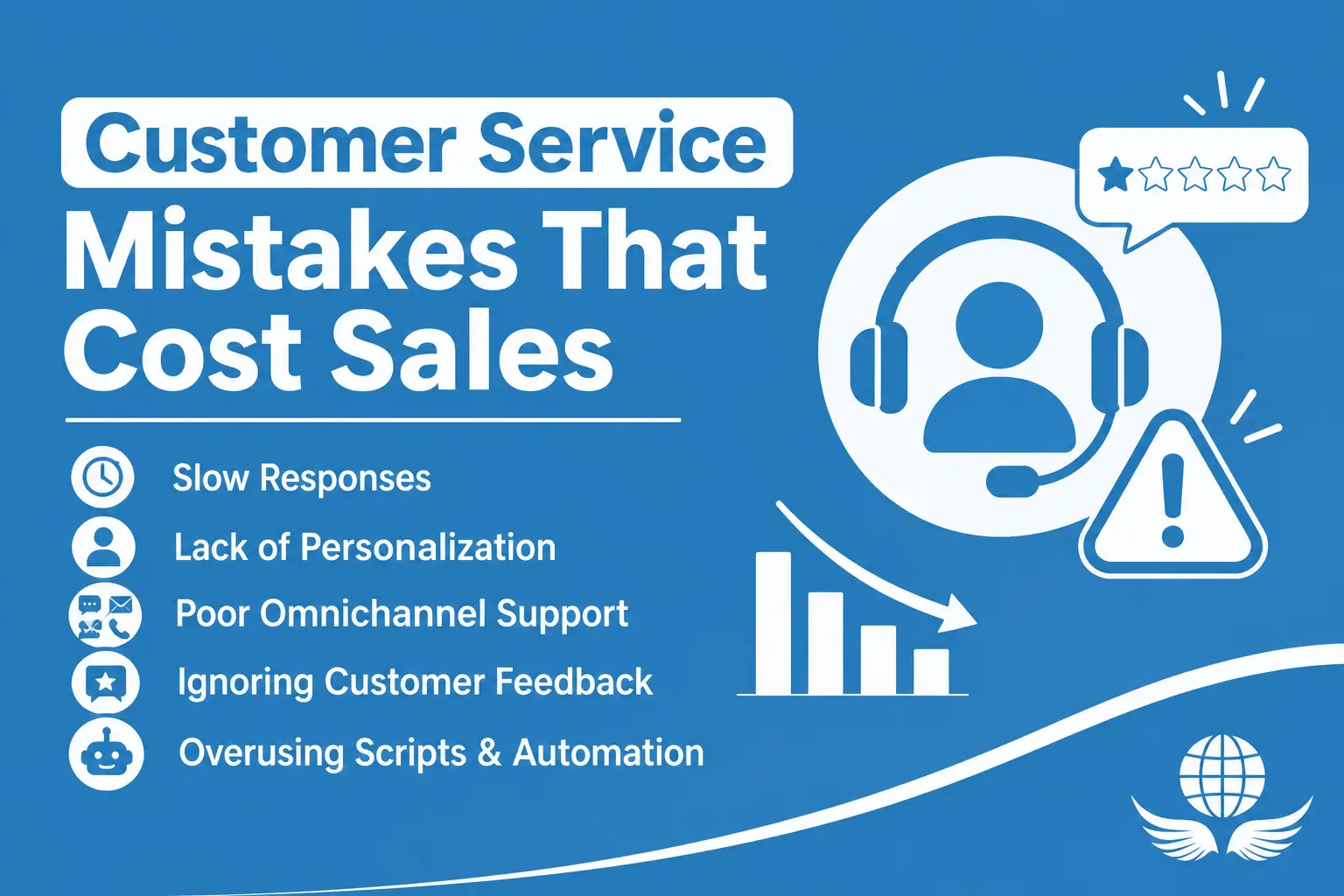
Several customer service mistakes that hurt sales are surprisingly common, even among growing companies.
Delayed Response Times
Modern customers expect quick support across email, chat, phone, and social channels. Delayed responses increase frustration and reduce conversion opportunities.
How to fix it: Define response time targets where applicable, staff during busy periods, and implement auto-replies with actual time estimates.
Lack of Personalization
Customers expect businesses to understand their history and preferences. Generic interactions make support feel transactional instead of helpful.
How to fix it: Address customers by name, display purchase history, and recall previous problems to make them feel recognized.
Poor Omnichannel Support
Customers want consistent experiences across every communication channel. Repeating the same issue multiple times creates unnecessary friction.
How to fix it: Get a platform that will keep the conversation on phone, email, and chat so customers never have to start from scratch.
Failing to Act on Customer Feedback
Ignoring customer feedback leads to repeated service failures and missed improvement opportunities.
How to fix it: Schedule monthly feedback reviews, address the top three most frequent complaints, and communicate with customers about what’s improved due to their input.
Over-Reliance on Scripts and Automation
Automation improves efficiency, but overusing scripted responses can make interactions feel impersonal and frustrating.
How to fix it: Do not use scripts as a rulebook, and refer emotional or complicated problems to experienced individuals.
Real-World Examples of Terrible Customer Service
Even big brands get it wrong. These well-known cases show how one bad interaction can become a public story.
United Airlines: “United Breaks Guitars” (2009)
United baggage handlers somehow ruined the $3,500 guitar of Halifax musician Dave Carroll, and months of claims haven’t gotten him anywhere. He composed a song about it and the video took off on YouTube, as reported by The Globe and Mail.
Lesson: A small claim handled badly can cost far more than the claim itself.
Comcast: The Cancellation Call that Went Viral (2014)
Ryan Block, a customer, captured the agent repeatedly pushing back while the customer tried to cancel his internet service. The video was shared online, and Comcast said it was “very embarrassed” and called for an apology, MPR News reported.
Lesson: Don’t make leaving harder than staying.
Amazon: A $7,455 Shipping Charge (2018)
A customer ordered three cartons of toilet paper from another seller on a third-party marketplace, asking to ship the items to him for a price of $7,455. She was reimbursed, but not until over two months ago, with a series of e-mails and after reaching out to a local TV station, Fortune reported.
Lesson: Customers see your brand, not your third-party seller, so own the fix.
Bank of America: The Tone Deaf Twitter Replies (2013)
A protester reported being pursued from a bank location, and the bank’s Twitter account responded with generic “glad to assist” comments, ignoring what the protester said. The Financial Brand described them as automated, boilerplate responses.
Lesson: Automation without context makes service feel worse, not faster.
Bad Customer Service Examples by Industry
Poor customer service examples look a little different in every industry. Here are common bad customer care examples by sector, and the fix for each:
Hospitality: Bad Guest Service
A guest arrives late at night, the room isn’t ready, and nobody answers the front desk phone.
Fix: Reservation lines that are open 24/7 and can actually fix the problem, plus travel and hospitality call center services.
Retail and eCommerce
During the holiday season, a call for ‘Where is my order?’ goes unanswered for days.
Fix: Proactive delivery updates and additional seasonal workers. Check our e-commerce customer support guide and our retail/eCommerce support.
Healthcare: Poor Customer Care at the Front Desk
The customer is waiting for 20 minutes just to register an appointment.
Fix: Callbacks, online booking, and reminder calls, handled by healthcare call center services.
Banking and Insurance
A fraud alert locks a customer’s card, and the support line has a 45-minute wait.
Fix: Priority routing for urgent issues like fraud and claims. Find out how insurance and finance companies are supported.
B2B and Professional Services: Bad Client Service
A client’s urgent ticket goes without any further action for three days.
Fix: Clear SLAs, a named point of contact, and regular status updates, as offered through technology call center services.
How to Fix Bad Customer Service and Win Customers Back
Every business gets it wrong sometimes. What matters is how quickly you recover, and whether you fix the cause so it doesn’t happen again.
Service Recovery in 5 Steps
- Acknowledge: Identify the problem and how the problem affects the customer.
- Apologize without excuses: Say I’m sorry this happened, not Sorry for any inconvenience.
- Handle it promptly: Fix it if possible through this contact, or at least set a clear schedule for the fix.
- Make it right: Offer a refund, credit, or upgrade that fits the size of the problem.
- Follow up and correct the root cause: Ensure that the resolution is successful and adjust the process leading to the root cause.
Metrics to Track So It Doesn’t Happen Again
- CSAT: How satisfied customers are after each contact
- Customer effort score (CES): How hard it was to get help
- First call resolution (FCR): If the problem was resolved during the initial contact.
- Repeat contact rate: Number of repeat calls by the same customer for the same query
- Abandonment rate and average wait time: How many callers hang up, and how long they waited
- QA scores: How reviewed calls rate on tone, accuracy, and ownership
Why Great Customer Service Is a Competitive Advantage
Excellent customer service directly contributes to business growth. Businesses that focus on delivering strong customer experiences often see benefits such as:
- Higher retention rates
- Increased referrals
- Stronger brand reputation
- Better customer loyalty
- Higher long-term revenue
Agents Republic Inc. was founded by industry professionals with decades of experience in customer service outsourcing. By providing omnichannel, multilingual support with globally distributed teams, the company helps businesses improve customer experience while scaling support operations efficiently.
Many of the reasons for poor customer service, such as insufficient staffing, extended wait times and zero after-hours coverage, are capacity issues. Those gaps can be filled readily by an outsourced team where trained agents can cover the peak hours or nights and weekends without an in-house hire.
Final Thoughts
Bad customer service is more than a support issue. It is a business risk that affects revenue, retention, reputation, and operational efficiency. The companies that consistently win customer loyalty are the ones that treat customer experience as a growth strategy, not just a support function.
Businesses that proactively improve response times, personalize interactions, and invest in scalable support systems are better positioned to retain customers and drive long-term growth.
Stop losing customers to bad service. Agents Republic provides 24/7, multilingual customer support for businesses across the US and Canada.
Frequently Asked Questions (FAQs)
What Are The Top 10 Customer Complaints?
Some of the most common customer frustrations include extended wait times, refund delays, unclear communication, billing errors, and unresolved concerns. Other top complaints include being transferred multiple times, having to repeat information, rude or unhelpful agents, no way to reach a human, and promised callbacks that never happen.
What Is Bad Customer Service?
Any interaction that leaves the customer frustrated, without a solution or not heard is bad customer service. Some of these are delays, transfers, impatience or helpless agents, or broken promises. In short, the customer has to work harder than the business to get the problem solved.
What Are the Most Common Customer Service Issues?
Top complaints against customer service are delays in service, slow response, and transfers between several agents without any solution or follow-up. The overwhelming majority of these are caused by under-resourcing, lack of training, and antiquated systems that cannot see a customer’s history. If most of those root causes are addressed, the complaints do not even occur, and there are no repeat calls.
How Should a Business Respond to Bad Customer Service?
When a problem occurs, the business should acknowledge the problem, state their apology and explanation of the problem situation, resolve the problem promptly, make it right, and touch base. If they do have poor customer service, they ought to correct the cause of the problem to help prevent others from experiencing the same problem. A speedy and forthright recovery can keep a customer, who considers leaving, on the market.
How Does Bad Customer Service Affect a Business?
Failure to deliver a good customer experience translates to more customers moving out the door, the cost of customer chase going up, negative reviews, fewer repeat sales, and fewer ongoing referrals. Also puts pressure on agents, leading to agent turnover. Each of these impacts, and the hidden revenue loss that many businesses fail to notice, is explained in our cost section above.